Recent Discoveries From the Cosmic Microwave Background a Review of Recent Progress
What is Planck and what is it studying?
What is the cosmic microwave background?
Why is it and then important to study the CMB?
When was the CMB showtime detected?
How many space missions accept studied the CMB?
What does the CMB expect like?
What is 'the standard model of cosmology' and how does it chronicle to the CMB?
What is Planck and what is it studying?
Planck is a European Space Bureau space-based observatory observing the Universe at wavelengths between 0.3 mm and 11.i mm (corresponding to frequencies between 27 GHz and 1 THz), broadly roofing the far-infrared, microwave, and high frequency radio domains. The mission'southward main goal is to study the catholic microwave background – the relic radiation left over from the Large Bang – across the whole sky at greater sensitivity and resolution than ever before. Planck is therefore similar a time car, giving astronomers insight into the evolution since the nascence of our Universe, nearly 14 billion years agone.
What is the cosmic microwave background?
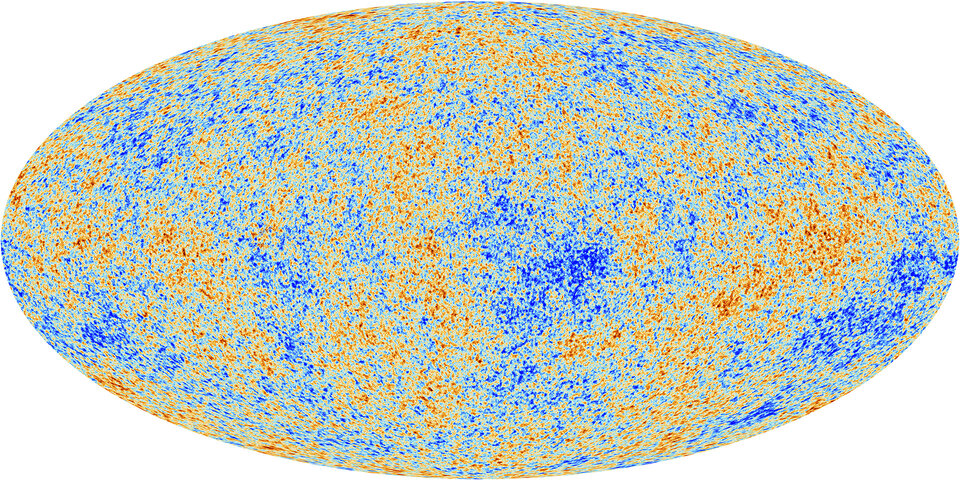
The catholic microwave background (or CMB) fills the entire Universe and is leftover radiation from the Big Bang. When the Universe was born, near 14 billion years ago, it was filled with hot plasma of particles (mostly protons, neutrons, and electrons) and photons (light). In particular, for roughly the first 380,000 years, the photons were constantly interacting with free electrons, meaning that they could not travel long distances. That means that the early Universe was opaque, like existence in fog.
Nevertheless, the Universe was expanding and as it expanded, information technology cooled, every bit the fixed amount of free energy within it was able to spread out over larger volumes. Afterwards most 380,000 years, it had cooled to around 3000 Kelvin (approximately 2700ºC) and at this point, electrons were able to combine with protons to form hydrogen atoms, and the temperature was too low to separate them once more. In the absence of free electrons, the photons were able to movement unhindered through the Universe: information technology became transparent.
Over the intervening billions of years, the Universe has expanded and cooled greatly. Due to the expansion of space, the wavelengths of the photons have grown (they have been 'redshifted') to roughly i millimetre and thus their effective temperature has decreased to just 2.7 Kelvin, or around -270ºC, just above absolute zero. These photons fill the Universe today (there are roughly 400 in every cubic centimetre of space) and create a background glow that can be detected by far-infrared and radio telescopes.
Why is it then of import to report the cosmic microwave background?
The cosmic microwave groundwork (CMB) is the furthest back in time we can explore using light. It formed well-nigh 380,000 years after the Large Bang and imprinted on it are traces of the seeds from which the stars and galaxies we can see today eventually formed. Hidden in the design of the radiation is a complex story that helps scientists to understand the history of the Universe both before and after the CMB was released.
When was the cosmic microwave background first detected?
The existence of the cosmic microwave background (CMB) was postulated on theoretical grounds in the tardily 1940s by George Gamow, Ralph Alpher, and Robert Herman, who were studying the consequences of the nucleosynthesis of lite elements, such as hydrogen, helium and lithium, at very early times in the Universe. They realised that, in order to synthesise the nuclei of these elements, the early Universe needed to be extremely hot and that the leftover radiation from this 'hot Big Bang' would permeate the Universe and be detectable even today as the CMB. Due to the expansion of the Universe, the temperature of this radiations has get lower and lower – they estimated at nigh v degrees above absolute naught (5 Thou), which corresponds to microwave wavelengths. It wasn't until 1964 that information technology was first detected – accidentally – by Arno Penzias and Robert Wilson, using a large radio antenna in New Jersey, a discovery for which they were awarded the Nobel Prize in Physics in 1978.
How many infinite missions take studied the cosmic microwave groundwork?
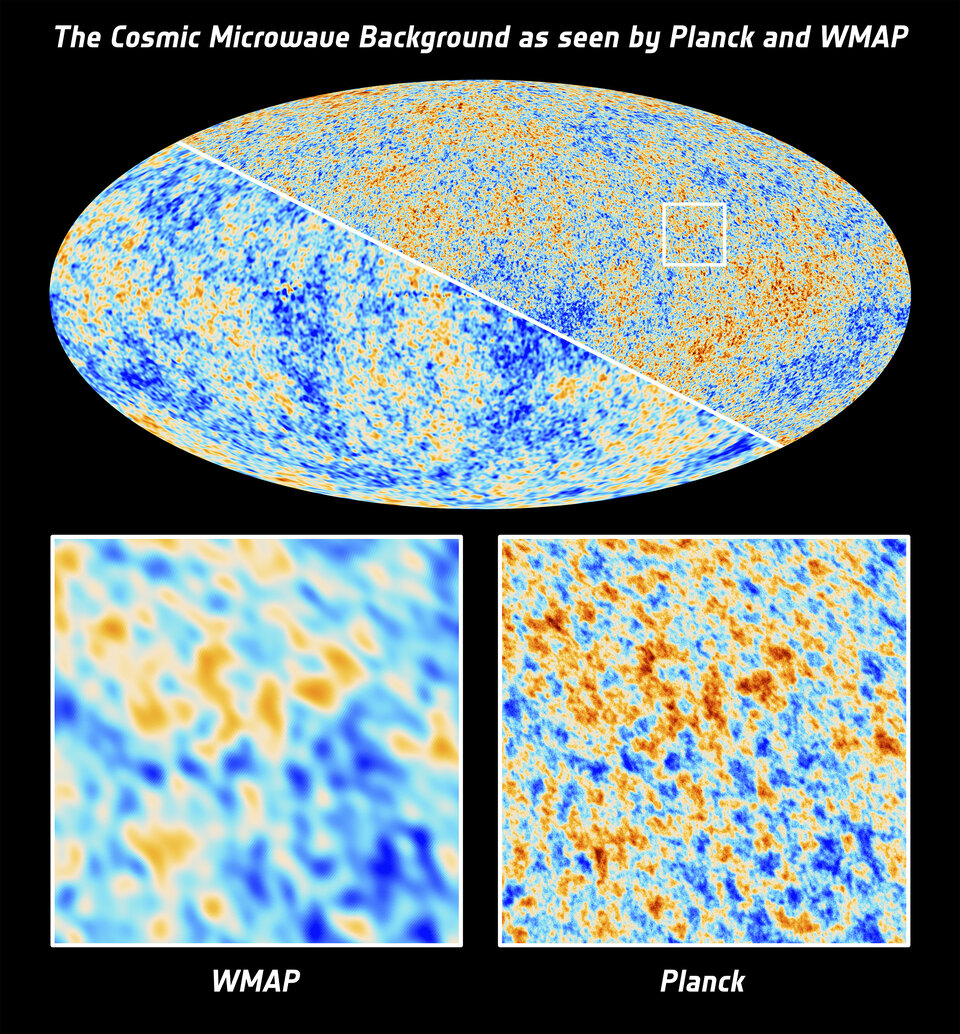
The offset infinite mission specifically designed to study the cosmic microwave background (CMB) was the Cosmic Groundwork Explorer (COBE), launched by NASA in 1989. Amidst its cardinal discoveries were that averaged beyond the whole sky, the CMB shows a spectrum that conforms extremely precisely to a so-chosen 'black torso' (i.due east. pure thermal radiations) at a temperature of 2.73 Kelvin, but that it also shows very small temperature fluctuations on the order of 1 part in 100,000 across the sky. These findings were rewarded with the award of the 2006 Nobel Prize in Physics to John Mather and George Smoot.
NASA's second generation infinite mission, the Wilkinson Microwave Anisotropy Probe (WMAP) was launched in 2001 to study these very small fluctuations in much more than detail. The fluctuations were imprinted on the CMB at the moment where the photons and affair decoupled 380,000 years after the Big Bang, and reflect slightly higher and lower densities in the primordial Universe. These fluctuations were originated at an earlier epoch – immediately after the Large Blindside – and would later abound, nether the consequence of gravity, giving ascension to the large-scale structure (i.e. clusters and superclusters of galaxies) that we see effectually u.s.a. today. WMAP'south results have helped determine the proportions of the fundamental constituents of the Universe and to constitute the standard model of cosmology prevalent today, and its scientists, headed past Charles Bennett, have garnered many prizes in physics in the intervening years.
Finally, ESA's Planck was launched in 2009 to written report the CMB in even greater detail than ever earlier. It covers a wider frequency range in more bands and at higher sensitivity than WMAP, making it possible to make a much more accurate separation of all of the components of the submillimetre and microwave wavelength heaven, including many foreground sources such as the emission from our own Milky way Galaxy. This thorough picture thus reveals the CMB and its tiny fluctuations in much greater particular and precision than previously achieved. The aim of Planck is to use this greater sensitivity to prove the standard model of cosmology beyond doubt or, more enticingly, to search for deviations from the model which might reflect new physics beyond it.
What does the cosmic microwave background look similar?
The catholic microwave background (CMB) is detected in all directions of the sky and appears to microwave telescopes as an almost uniform background. Planck's predecessors (NASA's COBE and WMAP missions) measured the temperature of the CMB to exist 2.726 Kelvin (approximately -270 degrees Celsius) almost everywhere on the sky. The 'nigh' is the most important factor here, because tiny fluctuations in the temperature, by just a fraction of a degree, stand for differences in densities of structure, on both small and large scales, that were present right after the Universe formed. They can be imagined equally seeds for where galaxies would somewhen abound. Planck's instrument detectors are so sensitive that temperature variations of a few millionths of a caste are distinguishable, providing greater insight to the nature of the density fluctuations present soon afterward the birth of the Universe.
What is 'the standard model of cosmology' and how does information technology relate to the CMB?
The standard model of cosmology rests on the assumption that, on very large scales, the Universe is homogeneous and isotropic, pregnant that its backdrop are very similar at every signal and that there are no preferential directions in infinite. In this model, the Universe was built-in well-nigh 14 billion years ago: at this time, its density and temperature were extremely high – a state referred to as 'hot Large Bang'. The Universe has been expanding ever since, as demonstrated by observations performed since the late 1920s. The rich diversity of structure that we can find on relatively small scales is the result of minuscule, random fluctuations that were embedded during cosmic inflation – an early menstruation of accelerated expansion that took place immediately after the hot Big Bang – and that would later grow under the upshot of gravity into galaxies and milky way clusters.
The standard model of cosmology was derived from a number of different astronomical observations based on entirely different physical processes. To reconcile the data with theory, however, cosmologists have added two additional components that lack experimental confirmation: dark matter, an invisible matter component whose web-like distribution on large scales constitutes the scaffold where galaxies and other cosmic construction formed; and dark energy, a mysterious component that permeates the Universe and is driving its currently accelerated expansion. The standard model of cosmology tin be described past a relatively small number of parameters, including: the density of ordinary matter, dark matter and dark energy, the speed of catholic expansion at the present epoch (also known equally the Hubble constant), the geometry of the Universe, and the relative amount of the primordial fluctuations embedded during aggrandizement on unlike scales and their amplitude.
Unlike values of these parameters produce a different distribution of structures in the Universe, and a different corresponding design of fluctuations in the CMB. By looking at the CMB, Planck can help astronomers extract the parameters that describe the state of the Universe before long after it formed and how it evolved over billions of years.
ethridgelattens60.blogspot.com
Source: https://www.esa.int/Science_Exploration/Space_Science/Planck/Planck_and_the_cosmic_microwave_background
0 Response to "Recent Discoveries From the Cosmic Microwave Background a Review of Recent Progress"
Post a Comment