How Early Can I File My 2018 Taxes
Tax is, more often than not, the most of import source of government acquirement in nearly all countries. According to the virtually recent estimates from the International Centre for Tax and Development, full revenue enhancement revenues business relationship for more than 80% of full government revenue in about one-half of the countries in the world – and more than than l% in almost every country.
We begin this entry past providing an overview of historical changes in taxation patterns, and then move on to an analysis of available data from the terminal couple of decades, discussing recent trends and patterns in taxation around the world.
From a historical perspective, the growth of governments and the extent to which they are able to collect revenues from their citizens, is a hitting economic feature of the last two centuries. The available long-run information shows that in the procedure of development, states have increased the levels of revenue enhancement, while at the same time changing the patterns of taxation, mainly by providing an increasing emphasis on broader tax bases.
Taxation patterns around the world today reveal big cantankerous-country differences, especially betwixt developed and developing countries. In particular, developed countries today collect a much larger share of their national output in taxes than do developing countries; and they tend to rely more than on income taxation to practice so. Developing countries, in contrast, rely more heavily on merchandise taxes, likewise as taxes on consumption.
Moreover, the data shows that developed countries really collect much higher tax revenue than developing countries despite comparable statutory taxation rates, even after controlling for underlying differences in economical activity. This suggests that cross-land heterogeneity in fiscal capacity is largely adamant past differences in compliance and efficiency of revenue enhancement collection mechanisms. Both of these factors seem to exist afflicted by the strength of political institutions.
In the concluding role of this entry we provide an overview of empirical evidence regarding the equity and efficiency implications of taxation. In item, nosotros prove that revenue enhancement does take a powerful redistributive consequence, just information technology is of import to consider how taxation likewise affects behavior of individuals, by changing economic incentives. For example, recent studies have establish that taxation may pb to efficiency losses by inducing migration of 'super stars'. These potential efficiency losses highlight the importance of designing taxation systems that attain redistributive objectives at the smallest possible cost.
All our charts on Taxation
History of taxation
Taxes started growing in early-industrialised countries afterward the Starting time Globe War
The visualization shows the evolution of taxation revenues, every bit a share of national income, for a selection of early-industrialized countries.
Equally nosotros can see, until 1920 tax revenues were low across all these countries. Indeed, until 1910 less than x% of national income was collected past these governments through tax – just enough for them to fulfil basic functions, such as maintaining order and enforcing holding rights.
After the First Globe War, however, taxation started growing considerably. In the period 1920-1980 tax as a share of national income increased drastically, more than than doubling beyond all countries in the nautical chart. These increases in taxation went together with more government expenditure on public services, especially education and healthcare.
Afterwards 1980, tax revenues started stabilizing, albeit with marked differences in levels for each state. Today these differences remain significant.
Income taxation played a fundamental role in the historical expansion of tax revenues
The growth of tax revenues that took place in early-industrialized countries after the First World War was largely supported by the extension of income taxes. This required states to build revenue enhancement assistants systems, and implement tax withholding at source, in order to effectively raise compliance.
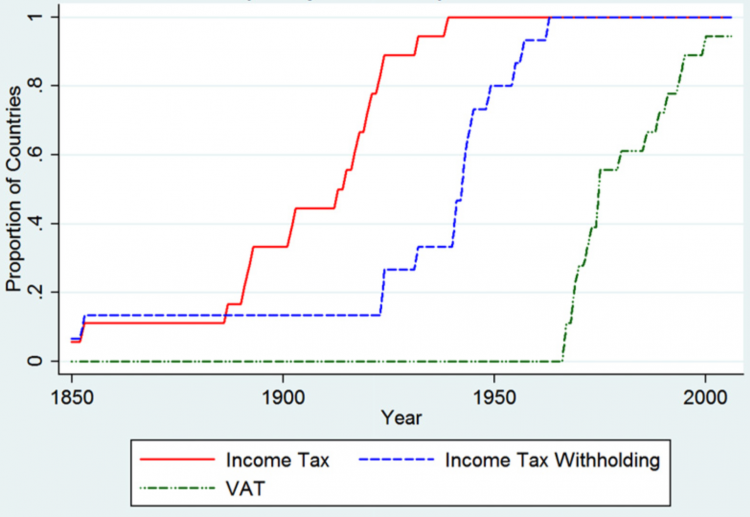
The visualization from Besley and Persson (2013)1 tracks a grouping of 18 countries, in order to show how different tax instruments became increasingly more mutual during the 20th century.
The vertical axis shows the relative frequency of revenue enhancement instruments within the sample of countries, and the horizontal axis shows time.two The carmine line plots the share of countries with income taxation, the blueish line plots the share with income-tax withholding, and the green line plots the share with value added taxation.
Equally we can encounter, income taxes began appearing around 1850, with direct withholding following near 25 years later; and VAT again somewhat later. By 1950 all countries in the sample had already both income taxation and direct withholding.
In this interactive nautical chart you lot can come across in detail how VAT, specifically, has spread around the globe in the final few decades.
Evolution of fiscal capacity in a sample of 18 countries – Figure 4 in Besley and Persson (2013)3
In the 20th century, European countries expanded revenues from direct taxation faster than other sources of government revenue
Equally pointed out above, early-industrialized countries increment revenue enhancement revenues after the First Globe State of war specifically past increasing directly forms of taxation. Here we provide further evidence of this, and bear witness how the tax of incomes became increasingly of import to collect revenues in these countries, also in relation to other sources of revenue.
The graph shows the proportion of total government acquirement that is accounted for by income tax. The data plotted corresponds to historical estimates from Flora (1983)4 upward until 1975, and more recent estimates, starting 1980, from the International Center for Tax and Development.
As we can see, the relative importance of income tax within regime budgets fluctuates with time, but at that place is a clear positive trend in most cases.
Revenue construction and government structure in the Us are historically interdependent
The experience of government expansion in the US shows that there is a link betwixt tax revenues, and regime structure more than generally.
As Wallis (2000)v points outs, in the concluding 2 centuries the US has passed through three distinct systems of government finance. In the first financial system, lasting from 1790 until near 1842, land governments played an important part in raising government acquirement, mainly by generating 'asset income' through activities such equally the sale of state. In the second financial organization, starting effectually 1840, local governments became more than of import, contributing an increasing share of government revenue from property taxes. And in the third system, starting with the Great Low, the federal government became more important, generating increasingly larger revenues through the drove of income taxes.
The visualization shows how this transition took identify. It provides details regarding the development of government revenues by level of authorities, expressed as a share of national income – here Gross National Product (GNP).
As tin be seen in the nautical chart, the implementation of new forms of taxation during the 20th century in the United states, was associated with underlying changes in the construction of the regime. Past clicking on the option labelled 'Relative', y'all can see how the share of national revenues rose sharply after the Second World War. This is when income tax revenues started expanding.
In the process of evolution, middle income countries have increased tax revenues
The show that we have discussed so far is mainly from high income countries. Even so, the bachelor long-run data from Latin America suggests that centre income countries have also expanded taxation revenues in the process of evolution – admitting after, and with some differences in the relative importance of specific tax instruments.
The visualization, using data from Arroyo-Abad and Lindert (2016)6, shows the composition of revenue enhancement revenues for Colombia. These estimates represent to fundamental government revenues, and are expressed every bit a share of national income – specifically Gross domestic product. Comparable data, from the aforementioned source, is also available for Peru; you lot tin can run into the corresponding figures by clicking on the option labelled 'Change'.
As we can see, tax revenues started growing noticeably in the 1960s, mainly through the collection of consumption taxes. By clicking on the pick labelled 'Relative', you tin can see the relative importance of the unlike tax instruments. As it can be appreciated, income taxation became an important source of revenue in the second half of the 20th century, although consumption taxation grew faster than income taxation throughout this menstruation.
Revenue enhancement today
What are the master instruments used by governments to collect acquirement?
In the preceding section nosotros discussed the historical evolution of authorities revenues, and provided evidence of the of import role that taxes, specifically, played in the expansion of governments. But what is the full menu of instruments that governments have to collect revenues?
Roughly speaking, governments finance policy from taxes, grants (typically in the form of 'evolution assistance' transfers), and debt (more precisely budget deficits, or reductions of budget surpluses).
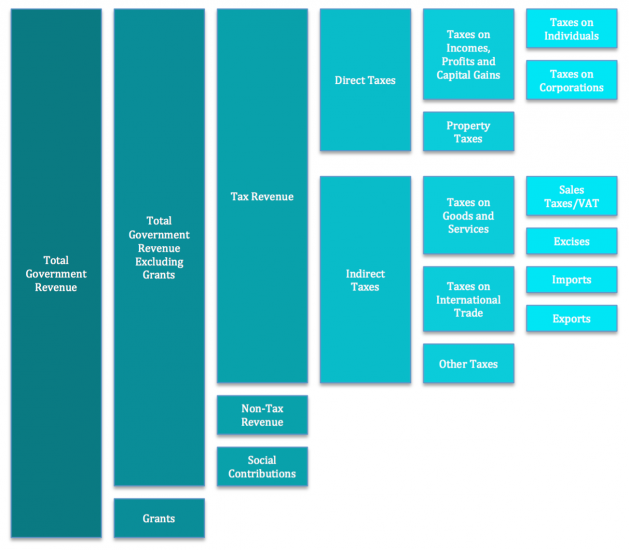
The diagram, from Prichard et al. (2014)7, provides a conceptual classification of revenues other than debt.
As we can see, these revenues include grants, straight taxes (such as taxes on income, profits, property, etc.), indirect taxes (such as taxes on consumption, sales, trade, etc.), and social contributions.
Classification of different sources of government revenues – Figure 2 in Prichard et al. (2014)eight
How much tax revenue practise countries collect today?
The visualization shows a map of full tax revenues. These estimates comes from the International Centre for Tax and Development, and are expressed as a share of GDP.
Equally nosotros tin can see from the most contempo data, at one extreme of the spectrum we accept countries such every bit Republic of cuba, France, Kingdom of denmark, Norway and Sweden, where total tax revenues are higher than thirty%. And at the other extreme, we accept countries such as Great socialist people's libyan arab jamahiriya and Saudi Arabia, where taxes account for less than 2% of national income.
More mostly, this map shows that there is a clear correlation between GDP and tax revenues – richer countries tend to collect through taxes a much larger share of their domestic production. This is a remark that we accost in more detail in the following sections.
The visualisation uses the same data, but plots the development of revenue enhancement revenues for individual countries. Yous tin add together countries by clicking on the choice ' Add country '; and you can switch between the 'map' and 'nautical chart' views by clicking on the tabs at the meridian of the graph.
The time series show that about high income countries accept had relatively stable levels of tax revenues in the last decade; while trends and patterns are less clear beyond the developing world. In many cases, specially amidst upper-middle income countries, tax revenues accept been going up consistently. The case of Turkey stands out: in 1980 it nerveless about 13.5% of Gdp in taxes (about half of the US), yet by 2001 it had nigh doubled taxation revenues – almost catching upwardly with the US.
In any example, despite specific cases such as Turkey, differences today remain large and in that location is no clear evidence of global convergence. In many developing countries levels are very low and trends have not been persistently going upwardly by a significant margin.
How do developing and developed countries compare in terms of tax revenue?
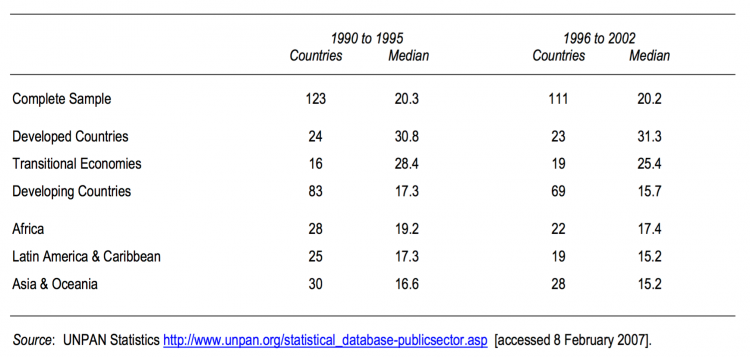
The table, from Jha (2008)9, shows differences in taxation revenues as a share of GDP for various land groups. The table pools countries within groups, beyond two periods of time: 1990-1995 and 1996-2002. For each time-group pool of countries, the author ranks countries by revenue enhancement revenue as share of national income, and reports the level for the country in the eye (i.eastward. the median tax revenue within that fourth dimension-group puddle). This gives united states an thought of the 'typical' country in that region, at that point in time.
As we tin can see, developed countries collect almost twice every bit much as developing countries in tax revenue. And developing countries, in turn, collect most half every bit much equally transition economies. Likewise, we can see that developed countries had little alter in tax-to-GDP ratios in the 2d half of the 20th century, where as in developing countries at that place seems to be a broad negative trend.
Primal Government Tax Acquirement as a Percentage of GDP, 1990–1995 and 1996–2002 – Table 1 in Jha (2008)x
Which forms of tax dominate revenues in different world regions?
We take already discussed the fact that levels of taxation differ profoundly across world regions – both in levels and trends. Now nosotros focus on differences in the composition of tax revenues.
The visualization presents a breakdown of tax acquirement sources, comparing figures from 1986 and 1996. The estimates are provided for a selection of country groups (y'all can switch state groups by clicking on the option 'change country group'), and are expressed as a share of Gdp. The data comes from Todaro and Smith (2014)11, and includes direct taxes (corporate and income taxes), as well as indirect taxes (full general, commodity and excise taxes) and social security contributions.
Although these estimates are somewhat dated, they practise provide a rough idea of taxation patterns by world regions. As it tin be seen, developing countries depend significantly on indirect taxes, peculiarly taxes on trade and consumption. This can be contrasted with the example of OECD countries, where straight taxation – peculiarly personal income revenue enhancement – is comparatively more important.
It is besides worth noting the important part of social security revenues in advanced economies: at 10% of GDP in 1996, social security revenues are about 10 times larger than in developing countries.
More recent data suggests that directly taxation, and specifically income taxation, remains more important in adult countries than in developing countries. The visualization plots total revenue from taxes on income and profits (horizontal axis) against revenue from taxes on goods and services (vertical centrality). Estimates comes from the International Centre for Taxation and Development and are expressed as share of GDP.
Equally nosotros can meet, there is a positive correlation on the aggregate, and European countries are consistently located further towards the peak right.
Information technology can too be checked that most countries in the OECD are close, or below a hypothetical line with slope equal to one (i.e. feature higher income tax revenues than commodity tax revenues); Denmark is an extreme case, with income tax revenues more than doubling receipts from taxes levied on appurtenances and services.
Taxation of incomes
How have income tax revenues evolved around the world?
The visualization provides an overview of revenues from income tax (specifically taxes on incomes, profits and capital letter gains) during the period 1980-2017. The estimates correspond to straight revenue enhancement of individuals and corporations, and are expressed as share of Gross domestic product. A selection of countries is included by default, but you tin can add more countries by clicking the ' Add country ' selection.
The data shows large and persistent cross-country heterogeneity, fifty-fifty within relatively similar countries, such as those in the OECD.
In comparison to developing countries, the data also shows that in adult countries the direct taxation of corporations and individuals accounts for a larger share of national production. And this has been consistently the example throughout the last couple of decades.
As noted before, an important part of authorities acquirement in developed countries comes from direct forms of taxation, so it is non surprising that the evolution of income tax tracks closely the stable evolution of tax revenues that we hash out above.
Some specific countries are particularly interesting. In China, for example, the share of Gross domestic product that is collected past taxing individuals and corporations about doubled in the period 2000-2012.
Marginal income tax rates from a historical perspective
Ane important characteristic of income revenue enhancement systems is the statutory rate of taxation that applies to the highest subclass of incomes. This mensurate, normally known as the 'top marginal rate of taxation', corresponds to the tax rate that applies to the 'last dollar' of income earned by the rich.
The chart here gives united states of america an thought of how income tax has inverse in rich countries, by plotting trends in superlative marginal rates across France, Frg, the US and the UK, for the menses 1900-2013.
As we tin see, at the plough of the 20th century the top earners in these countries faced nigh nix taxation on the last part of their incomes; merely this changed drastically around 1910-1930, when high superlative marginal rates were introduced. Interestingly, notwithstanding, this lasted only until nigh 1980, when again all countries essentially reduced rates. Today the levels are between half and a tertiary of what they used to be at the highest signal. In the Great britain, in 1978 the last pound of earned income at the highest bracket was essentially entirely taxed (98%). Today the corresponding effigy is less than half (45%).
How accept statutory tax rates for the rich evolved in the last few decades?
The chart here shows the sharp trend of reducing tiptop marginal tax rates after the 1980s, equally a global phenomenon expanding both adult and developing countries.
The estimation of this graph frequently leads to defoliation. A common mistake is to interpret the height marginal revenue enhancement charge per unit as the constructive charge per unit of tax applied to the rich. This is incorrect, because the elevation marginal charge per unit applies (as the 'marginal' proper noun suggests) only to the last portion of income earned by the rich. And by implication, lower marginal rates do not directly imply lower economic incidence of tax for the rich.
Having said that, additional evidence does seem to suggest that the reduction of tiptop marginal income tax rates has been one of the ingredients contributing to lower effective tax rates for the rich. We discuss this additional evidence in the next department.
How do marginal rates of taxation compare to boilerplate rates of taxation?
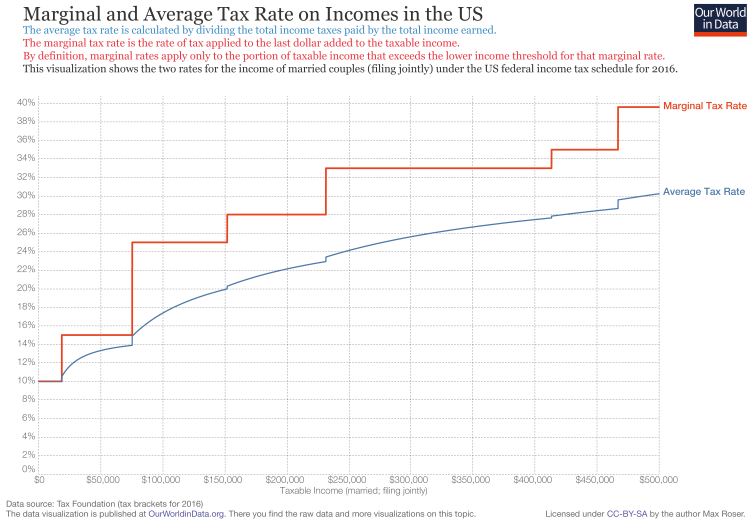
The marginal rate of tax is defined as the charge per unit of tax that is practical to the 'last dollar' added to the taxable income. This means that marginal rates utilise but to the portion of taxable income that exceeds the lower income threshold for that marginal rate.
In contrast, the average, or constructive charge per unit of taxation is defined as the ratio of total taxes paid past total income earned – that is, the share of income that is paid in income taxes.
The distinction betwixt these two concepts is important because for many people, a portion of their income is taxed at 1 rate, and the balance is taxed at another rate. In the U.s.a., for example, if a married couple earns $twoscore,000 a yr, they pay federal income taxes at a rate of ten% on the commencement $18,500 or so, and at a rate of 15% on the rest. Hence, while the marginal rate practical to the last dollar earned is fifteen%, the effective income revenue enhancement rate is lower.
Using the US federal income tax schedule, the visualization shows the marginal and average rates for the income of married couples (filing jointly). These figures use estimated tax brackets for 2022 from the Tax Foundation.
This visualization shows that average and marginal income tax rates are clearly different. Specifically, while both average and marginal rates are increasing, average rates are smoother and mostly lower.
A similar chart showing marginal and boilerplate rates for the income of single individuals – every bit opposed to married couples filing jointly – can be institute here.
Marginal and average tax rate on incomes in the Usa – Our Globe in Data, with 2022 estimates from the Taxation Foundation
Taxation of consumption
How is consumption taxed?
Nosotros accept already outlined above the main instruments used by governments to collect revenue. Hither we want to provide more particular regarding different forms of 'commodity taxation', in particular consumption taxes.
In the OECD nomenclature, consumption taxes (taxes on production, sale, transfer, leasing and commitment of goods and rendering of services) include 2 sub-categories: general taxes on goods and services (taxes on full general consumption including VAT, sales taxes and other general taxes on goods and services) besides as taxes on specific appurtenances and services consisting primarily of excise taxes (as well equally customs and import duties and taxes on specific services, such as taxes on insurance premiums and financial services). For more than details see OECD (2016).12
The primal distinction between VAT and excise taxes is that VAT is paid by consumers, while excise taxes are paid by producers. In other words, they take a unlike statutory burden. As we hash out beneath, the statutory burden of a tax does not necessarily describe who really bears the economic burden of the taxation.
How has the taxation of goods and services evolved around the globe?
The visualization provides an overview of revenues from the revenue enhancement of goods and services during the menstruation 1980-2017. The estimates account for sales taxes, value added taxes and excise duties; and are expressed as a share of GDP.
The data shows some cross-land heterogeneity; although relative to revenue from income taxation, heterogeneity in commodity taxation is much smaller, especially among high-income countries.
Equally can be seen, most of the countries with particularly low taxation-to-GDP ratios are in Africa.
How important are different forms of commodity taxation in OECD countries?
Nosotros have already noted that taxes on appurtenances and services tend to be less important in high-income countries than in low-income countries. Here we want to focus on the relative importance of different forms of article taxation.
The visualization plots the evolution of VAT and excise taxes in the OECD. The figures represent to OECD averages and all values are expressed equally percentage of total tax. These figures give us an thought of the development of the importance of unlike forms of article taxation in OECD countries.
As we can run across, the composition of consumption taxes has fundamentally inverse in the OECD over the last few decades: the weight of consumption taxes has been stable, because the substantially increased importance of VAT has been effectively counterbalanced by a reduction in importance of other taxes on specific goods and services, the majority of which are excise taxes.
How practice statutory consumption tax rates compare across countries?
The visualization shows how value added tax rates compare between globe regions. These figures come from the Globe Evolution Report (2005), and include corporate tax rates equally a benchmark.
This visualization shows that value added tax rates are similar in developed and developing countries, which suggests that the differences we discover in revenue between regions, are likely due to differences in compliance. In fact, this is not only specific to commodity taxation – Besley and Persson (2013)xiii show that adult countries tend to heighten much more income-revenue enhancement acquirement than developing countries with comparable statutory rates, which suggests that the taxation base in low-income countries is more strongly affected past compliance difficulties.
In summary, the evidence suggests that fiscal capacity (i.e. the extent to which countries tin can extract revenues through tax at any given level of economical activeness) is considerably less adult in poor countries.
How common are VAT exceptions?
Most VAT systems around the earth prefer multi-rate systems with i or more than reduced rates applying to particular goods. The chart, from OECD-KIPF (2014),14 shows the goods and services that are virtually commonly subject to reduced VAT rates in OECD countries.
As can be seen, in most countries that use VAT exceptions, reduced rates tend to apply to basic products in which depression-income households spend a larger share of their income (such as food); every bit well as to products with perceived positive social spillovers (such as newspapers, books and medicines).
Many countries as well use reduced rates for other reasons. From this chart, it seems like providing support to specific industries, such as tourism, is another important factor considered past governments.
Common reduced VAT rates in OECD countries (as at 1 Jan 2014) – OECD-KIPF (2014)15

Recent trends in the incidence of revenue enhancement
Taxes affect market place prices, so the statutory brunt of a taxation does non describe who really bears the revenue enhancement
Taxes touch on economic interactions by changing the relative prices of goods and services in the economy. This implies that, to assess who bears the burden of a tax, information technology is non sufficient to expect at statutory tax rates. For example, if a taxation is imposed on producers, in a competitive market they volition raise prices to some extent to offset this taxation burden – and then the producers' income will not autumn past the total corporeality of the revenue enhancement. A similar argument can exist fabricated if the tax is levied on consumers, since in a marketplace economy the tax will lower need, and this volition accept a consequence also for producers.
The key betoken is that, in order to analyze the economical incidence of taxation in a market economic system, we need to look beyond statutory tax rates. Below we provide concrete examples of how economists attempt to estimate the economic incidence of revenue enhancement.
How much taxes practise rich households pay in the US?
In the U.s., the Congressional Budget Part (CBO) produces estimates of the incidence of taxation beyond the population. To exercise this, they make the following assumptions: (i) Taxes on earnings are borne past workers; (ii) Taxes on private income are borne by the households that pay them; (three) Taxes on corporate income are borne past individuals in proportion to their upper-case letter income; (4) Taxes on consumption are borne past individuals in proportion to their consumption.16
Based on these assumptions, the CBO calculates total revenue enhancement contributions as a share of pre-tax income for unlike segments of the pre-tax income distribution.17 These estimates, often referred to as 'average revenue enhancement rates', can be interpreted as the effective rates of taxation that apply to individuals with different incomes, afterward bookkeeping for government transfers (specifically cash payments and in-kind benefits from social insurance and other authorities assistance programs).
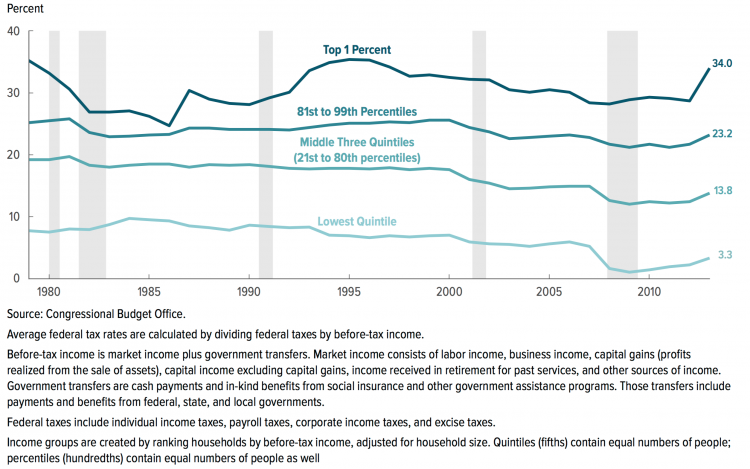
The visualization, plotting CBO estimates of boilerplate revenue enhancement rates, shows that the federal taxation system in the US has been generally progressive: those located college in the ranking of incomes, pay a higher share of their income in taxes.
Across time, we tin can also see that progressivity has not been constant – the period 1980-1990 saw important reductions in tax rates for the rich, without comparable reductions for the poor.
The hike in tax rates towards the finish corresponds primarily to significant changes in tax rules in 2012. Upwardly until that bespeak, and since around 1995, tax rates for the richest 1% went downwardly every twelvemonth (although they besides went downwards for the lower income groups in the aforementioned period).
Average federal revenue enhancement rates, by before-tax income Group, 1979 to 2022 – Figure 2 in CBO (2016)xviii
How progressive is taxation at the top of the income distribution in developed countries?
The visualization above shows that, according to the estimates from the Congressional Budget Office, richer individuals in the US mostly tend to bear a larger burden of revenue enhancement than the poor. Here we examine whether this is also true inside the peak of the income distribution – that is, whether the 'ultra rich' shoulder a larger tax brunt than the 'rich'.
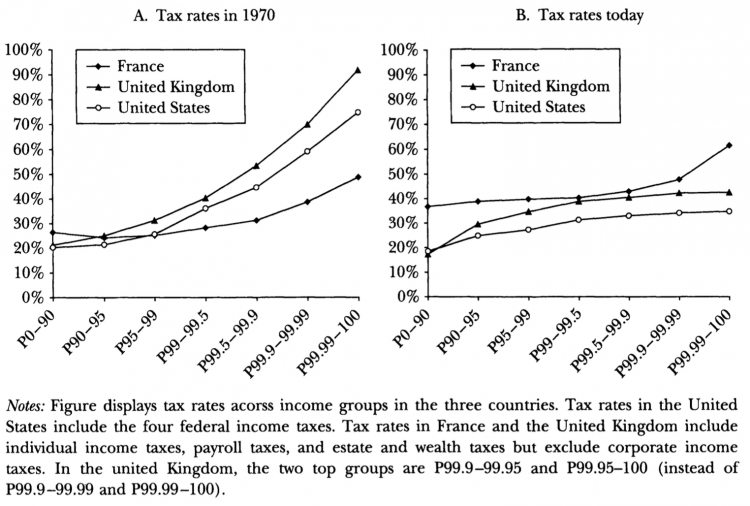
The next visualisation, from Piketty and Saez (2007)19 shows estimated average tax rates in France, the US and the UK, at two points in time: 1970 and 2005. Notice that these are boilerplate rates (i.due east. total tax contributions as a share of pre-tax income), which are different to marginal tax rates.
Displayed are rates for the lesser 90% of the income distribution, besides as higher percentiles. Once again, we tin can encounter in these estimates that the systems in question are progressive – increasingly higher percentiles in the income distribution pay increasingly higher effective rates of tax. However, the lines are much flatter in 2005, which shows that the systems have become less progressive at the pinnacle: the average share of income paid by those at the very top of the income distribution has dropped substantially since 1970. This is important because, every bit the authors of the effigy point out, over the same menstruation pre-tax income inequality grew significantly: a few very rich individuals at the very top are accumulating an increasingly large share of national incomes.
An important point that should be kept in mind is that these estimates are not direct comparable to those from the Congressional Budget Role discussed above, considering they do non accept into account regime transfers, and rely on dissimilar methodological assumptions – for example, they exercise not consider excise taxes (just they practice consider estate taxes). For more details see Piketty and Saez (2007).
Average taxation rates past income groups in French republic, the United Kingdom, and the United States, 1970 and 2005 – Figure 4 in Piketty and Saez (2007)twenty
The drivers of tax revenues
Ascension GDP is associated with rising tax revenues
We have already pointed out that rich countries tend to collect much higher taxation revenues than poor countries. The visualization provides further bear witness of the extent of this correlation.
The vertical axis measures Gdp per capita (after bookkeeping for differences in purchasing ability across countries), while the horizontal axis measures taxation revenues as share of GDP. The vertical centrality is expressed past default in a logarithmic scale, so that the correlation is easier to capeesh – you lot can alter to a linear scale past clicking the 'Log' push.
We can run across that there is a strong positive correlation: richer countries tend to take higher tax revenues every bit a share of their GDP. And this is also true within world regions (represented here with dissimilar colors).
Early-industrialized countries became better at collecting revenue as they developed
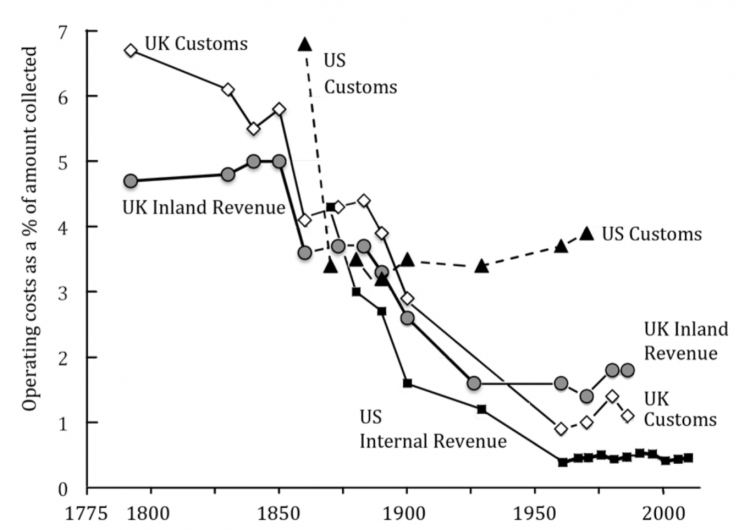
We argued above that the efficiency of revenue enhancement drove is a strong predictor of cross-land differences in taxation revenues – rich countries take more capacity to extract revenues. As historical data shows, this capacity was largely possible because, throughout the 19th century and upward until the first half of the 20th century, these countries plant increasingly cheaper ways to collect taxes.
The visualization, from Lindert (2012)21, shows that the US and the United kingdom of great britain and northern ireland saw steep declines in the administrative cost shares of indirect tax collection across the 19th century and the early 20th. As we tin can come across, the price of collections dropped, from over 4.5% of the amounts collected in the mid-19th century, to 2% since the middle of the 20th century.
Tax collection costs equally a percentage of the amount collected past fundamental governments, US and UK, 1787/96-2011 – Figure 2 in Lindert (2012)22
Tax collection relates to the strength of political institutions
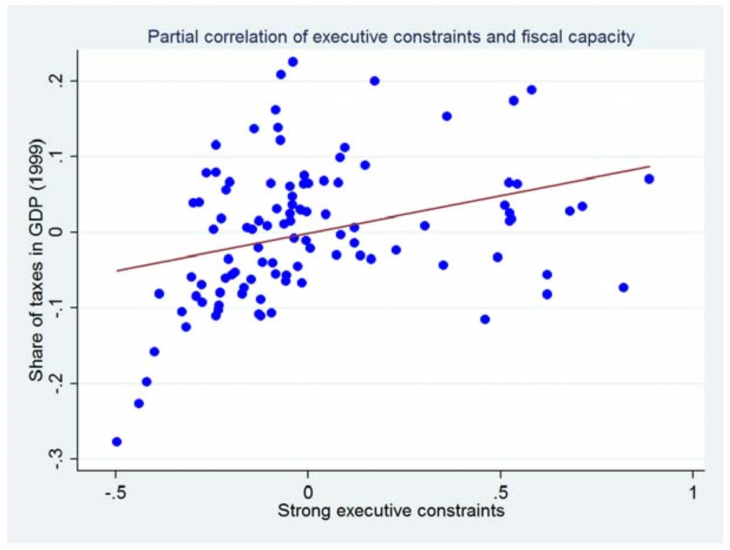
Cantankerous-country differences in revenue enhancement revenues are linked to the capacity of countries to implement efficient tax collection systems. Hither we provide evidence suggesting that political factors – such as the extent of institutionalized constraints on the controlling powers of policy makers – assistance shape the level and evolution of financial capacity of countries.
The chart, from Besley and Persson (2013)23, plots the cantankerous-land relationship between political institutions and tax revenues. The authors approximate the strength of political institutions by calculating the proportion of years since independence (or since 1800 if independence is before) that a land had strong constraints on the executive. Having 'strong constraints on the executive', in plow, is measured from the well-known Polity IV information base of operations (y'all tin read about measurement and definitions in the Polity IV dataset users' manual). In essence, this variable aims to capture the extent to which accountability groups impose institutionalized constraints on the decision-making powers of policy makers.
The scatter plot controls for baseline differences in GDP – that is, what we observe is the correlation between tax revenues and political institutions conditional on GDP levels. As we tin can see, countries with strong executive constraints collect college taxation revenues, when income per capita is held abiding, than exercise countries with weak executive constraints.
Some studies suggest that, under weak accountability, countries may not but accept generally weak taxation systems, simply may likewise be subject to 'political budget cycles' whereby tax collection declines prior to elections, as politicians seek to secure short-term political back up (See Prichard 201624 and the references therein for more details).
Taxation revenue vs constraints on executive authority
Assist correlates negatively with revenue enhancement revenue, but the link does non seem to be causal
A big body of academic literature has studied the relationship between revenue from development assistance ('strange assistance') and revenue from taxation. The hypothesis supporting this strand of literature is straightforward: strange assistance may 'crowd out' domestic tax revenues, as it reduces the incentives for policy-makers to pursue politically plush revenue enhancement collection.
This hypothesis seems to be supported by raw correlations. The plot, from Benedek et al. (2014)25, shows the development of tax revenues and foreign aid (Overseas Development Assist – ODA). It shows a broad negative clan: betwixt 1980 and 1995, when foreign assist as a share of Gdp was increasing, average tax revenue in relation to Gross domestic product decreased slightly. Post-1995, a pass up in the share of total net ODA to Gross domestic product was accompanied by higher tax revenues as percentage of Gross domestic product.
This relationship cannot be interpreted causally, as there are many factors that simultaneously bulldoze ODA flows and revenue enhancement revenues. More circuitous econometric studies that endeavor to account for further sources of bias find that there is no consistently significant relationship between assistance and taxation collection (come across Prichard 201626 and the references therein for more details).
Average net development assistance and tax acquirement in low and center income countries, 1980–2009 – Effigy i in Benedek et al. (2014)27

The consequences of tax
Taxation is an important instrument to reduce inequality
One way to gauge the extent to which taxation redistributes resources between individuals in a country, is by looking at how the distributions of incomes change before and after taxes. The visualization does this, showing the reduction of inequality that different OECD countries attain through taxes and transfers.
The estimates represent to the percentage point reduction in inequality, as measured by changes in the Gini coefficients of income, before and after taxes and transfers. The source for the data is the 2022 OECD Inequality Update as role of the OECD Income Distribution Database (IDD) November 2022 Release: Income inequality remains high in the face of weak recovery. The IDD provides further details regarding how these estimates are constructed. In a nutshell, income 'before taxes' corresponds to what is usually known every bit market income (wages and salaries, self-employment income, capital and property income); while income after taxes and transfers corresponds to dispensable income (market income, plus social security, greenbacks transfers and private transfers, minus income taxes).
The data shows that across the 35 countries covered, taxes and transfers lower income inequality by around i-third on boilerplate (equivalent to around 0.fifteen Gini points). However cross-country differences are substantial, with declines ranging from about twoscore% in Kingdom of denmark and Republic of ireland, to most 8% in South Korea. The US – a land with high baseline levels of inequality – achieves a reduction of around 17%, which is a little over half of the OECD average.
Generally speaking, countries that achieve the largest redistribution through taxes and transfers tend to be those with the lowest after-tax inequality.
While informative for the purpose of cross-country comparisons, these results accept to be interpreted carefully, since the before-revenue enhancement distribution of incomes is already the consequence of choices made past individuals who take taxes and transfers into consideration. Put only, the before-tax distributions of incomes are likely to be different to the actual distributions of incomes that would be in place if at that place were no taxes or transfers. This can exist clearly explained in the context of pensions: individuals receiving country pensions appear in the data as poor earlier transfers; simply many of them would of class have private pensions if they lived in a country without land transfers.
The extent to which taxes affect behavior is discussed in more than particular beneath.
Taxation tin can lead to efficiency losses
In marketplace economies, consumers and producers change their behavior in response to taxes. For example, if a taxed good has a substitute that is non taxed, some consumers will shift to the substitute to avoid the revenue enhancement. These changes in behavior can pb to inefficiencies. For example, high taxation rates may discourage labor supply; and in the instance of very rich individuals, they may even induce migration of talent to countries where the tax burden is lower. In both cases, the 'size of the pie' would be reduced by revenue enhancement. So how large are these behavioral responses?
Using information from the European football market place, Kleven et al (2013)28 discover evidence of strong mobility responses to revenue enhancement for 'superstars'. The scatterplots support this.
The two plots correspond to different fourth dimension periods. The vertical axis represents the fraction of all top-league professional football players who are foreign nationals in the country where they play, and the horizontal axis shows the average top earnings tax rate for strange players in that country.
As we tin can encounter, in the period 1985-1995 there was no correlation between migration and tax rates; withal in the menstruum 1996-2008, after the Bosman ruling on free mobility was enacted, the correlation became strongly negative: the countries with higher pinnacle earnings revenue enhancement rates became less likely to have foreign players.29
The authors also show that the mobility of players had a negative impact on the functioning of football clubs of countries with high taxation rates.
This evidence, suggesting that 'superstars' are very responsive to taxation, contrasts with the available evidence for typical individuals – while even so highly debated, most empirical estimates suggest that for the majority of the population, labor supply choices are non very responsive to changes in income taxation rates (see Saez et al. 201230 for a review of the literature).
Cross-land correlation betwixt revenue enhancement rates and migration of football players – Figure 1 in Kleven et al (2013)31

Definitions & Measurement
The most widely used global data source on taxation is the International monetary fund Authorities Finance Statistics (GFS) . This is the source used to produce the World Development Indicators from the World Bank, and is an input for the production of many other related, simply dissimilar sources of information, including (i) the OECD Revenue enhancement Statistics dataset; (2) the OECD Revenue Statistics in Latin America dataset; and (iii) the CEPALSTAT Revenue Statistics in Latin America database
Combining data from all these sources, the International Centre for Tax and Development (ICTD) produces the ICTD Government Revenue Dataset.
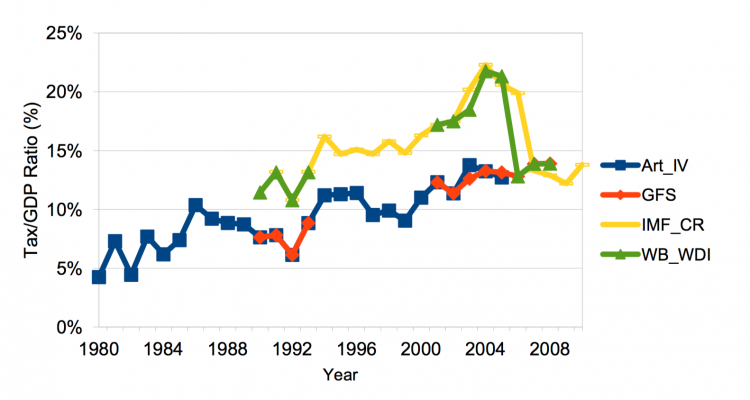
The data produced by the IMF, the Earth Banking company, the OECD and CEPAL often covers different countries at dissimilar points in time; and for those years and countries in which estimates overlap, there are pregnant inconsistencies.
The inconsistencies betwixt sources are often due to differences in methodological choices – such as differences in the classification of social security contributions, or the omission of data from taxes collected by local governments. And in addition to methodological differences, sources likewise seem to differ in other substantial not-systematic means. A very detailed account of data quality differences tin can be establish in Prichard et al. (2014).32
The chart shows an example of data discrepancies in taxation revenues for Ghana. The different serial correspond to different sources: the blue line denotes estimates using IMF Article Four reports, the orange line denotes estimates from the International monetary fund Regime Finance Statistics, the yellow line denotes information from International monetary fund Country Reports, and the green line denotes estimates from the Globe Bank World Development Indicators.
Considering the above data limitations, the ICTD developed the new Regime Revenue Dataset, merging and prioritizing sources under a standard classification system. Prichard et al. (2014)34 provide a detailed account of the data limitations identified by the ICTD, and how they tried to accost them in the new ICTD Regime Revenue Dataset.
Alternative measures of Tax revenue (% GDP), Republic of ghana, 1980-2010 – Effigy 2 in Prichard 201633
Data Sources
Historical cantankerous-country series
Flora et al. (1983)
- Information Source: Flora, Peter et al. 1983. Country, Economy and Lodge in Western Europe, 1815-1975. Frankfurt: Campus Verlag
- Clarification of bachelor measures: Tax revenues by source
- Time bridge: 1815-1975
- Geographical coverage: Western Europe
- Link: http://gpih.ucdavis.edu
Piketty (2014)
- Data Source: Piketty, T. (2014). Capital in the 21st Century. Cambridge: Harvard University Press
- Description of bachelor measures: Tax revenues (share of national income) and marginal tax rates
- Time span: Total tax revenues 1815-2008, Marginal Tax Rates 1900-2013
- Geographical coverage: Selected countries in Western Europe
- Link: http://piketty.pse.ens.fr/en/capital21c2
Arroyo-Abad and Lindert (2016)
- Data Source: Arroyo Abad, L. and P. Lindert. "Fiscal Redistribution in the Americas since the Mid-Nineteenth Century" in Latin American Inequality in the Long Run, edited by L. Bertola and J. Williamson, forthcoming.
- Description of available measures: Revenue enhancement revenues past source
- Time span: 1901-2013
- Geographical coverage: Selected countries in Latin America
- Link: http://gpih.ucdavis.edu
Upwardly-to-engagement cross-state series
OECD.stat
- Data Source: OECD Revenue Statistics, OECD Latin American Tax Statistics
- Description of available measures: Taxes and other government revenues (share of GDP), equally well every bit selected statutory taxation rates and thresholds
- Time bridge: The longest series comprehend 1965-2014, merely many countries have significantly shorter series
- Geographical coverage: OECD member countries and other selected countries from Africa, Asia and Latin America
- Link: http://stats.oecd.org/
World Banking concern Data
- Data Source: Globe Evolution Indicators and IMF Government Finance Statistics
- Clarification of available measures: Taxes and other government revenues (in current local currency units, as share of Gdp, and as share of government revenues)
- Time span: The longest serial comprehend 1970-2014, simply many countries have significantly shorter series
- Geographical coverage: Global past state
- Link: https://data.worldbank.org
CEPALSTAT
- Data Source: Economical Committee for Latin America and the Caribbean
- Description of available measures: Revenue enhancement acquirement by blazon of taxes (in current local currency units and as share of GDP), as well equally selected statutory tax rates
- Time span: Most series cover 1990-2013, simply some are shorter
- Geographical coverage: Latin America and the Caribbean
- Link: http://estadisticas.cepal.org
ICTD Government Revenue Dataset
- Data Source: International Center for Tax and Evolution, using data from OECD Acquirement Statistics, OECD Latin American Revenue enhancement Statistics, International monetary fund Government Finance Statistics, International monetary fund Article IV Staff Reports, and CEPALSTAT Revenue Statistics in Latin America
- Description of available measures: Taxes and other government revenues (share of Gdp)
- Time span: Near serial cover 1980-2013, but some are shorter
- Geographical coverage: Global past country
- Link: http://www.ictd.ac/datasets/the-ictd-government-revenue-dataset
OECD Global Revenue Statistics Database (GRSD)
- Data Source: OECD, using data from the four 'Revenue Statistics' publications: 'Revenue Statistics in Africa', 'Revenue Statistics in Asian and Pacific Countries', 'Revenue Statistics in Latin America and the Caribbean', and the OECD'southward 'Acquirement Statistics'
- Description of available measures: Taxes and other government revenues (share of Gross domestic product) to provide internationally comparable tax revenue statistics for participating countries
- Fourth dimension span: 1990 to 2016, dependent on state
- Geographical coverage: 80 countries, set to aggrandize to 90 countries by the finish of 2018
- Link: https://stats.oecd.org/Alphabetize.aspx?DataSetCode=RS_GBL
ethridgelattens60.blogspot.com
Source: https://ourworldindata.org/taxation
0 Response to "How Early Can I File My 2018 Taxes"
Post a Comment